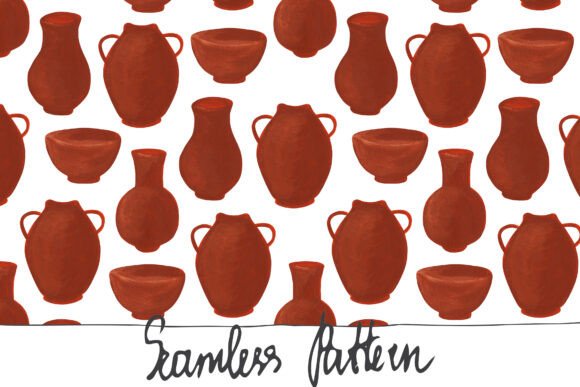
Evaluating the Clay Pots Seamless Pattern for Professional Design Projects
When selecting digital assets for creative projects, the distinction between a generic texture and a purpose-built design element often determines the final quality of the work. The Clay Pots Seamless Pattern represents a specific category of hand-painted digital resources that bridges the gap between traditional craftsmanship and modern digital utility. Unlike vector-generated graphics or AI-synthesized textures, this pattern is derived from actual acrylic paintings, offering an organic irregularity that is difficult to replicate algorithmically. Understanding the nuances of this asset—including its resolution, color profile, and intended application—is essential for designers, scrapbookers, and product creators who need to ensure their final output meets professional standards.
The Distinction of Hand-Painted Acrylic Textures
The primary value proposition of the Clay Pots Seamless Pattern lies in its origin. Created using acrylic paints, the texture captures the physical properties of the medium, including brushstroke variance, pigment density, and the subtle imperfections inherent in manual artistry. When compared to flat, computer-generated patterns, hand-painted options provide a depth of character that resonates more effectively with audiences seeking authenticity. This is particularly relevant in industries such as home decor, artisanal packaging, and lifestyle branding, where a "perfectly imperfect" aesthetic is often preferred over sterile precision.
Furthermore, the seamless nature of the pattern allows for infinite tiling without visible breaks or seams. This is a critical technical feature for users intending to cover large surfaces, such as fabric rolls, wallpaper, or expansive web backgrounds. While many free resources claim to be seamless, they often suffer from visible repetition artifacts or mismatched edges. A professionally prepared file ensures that the transition from one tile to the next is invisible, maintaining the illusion of a continuous, hand-crafted surface regardless of the scale of application.
Technical Specifications and Quality Standards
For professionals evaluating digital assets, technical specifications are not merely details; they are decision-making factors that dictate usability. The Clay Pots Seamless Pattern discussed here is provided as a high-resolution JPG file, measuring 12x12 inches at 300 DPI (dots per inch), with dimensions of 3600x3600 pixels. These specifications are significant for several reasons:
- Print Readiness: A resolution of 300 DPI is the industry standard for high-quality print production. Whether the pattern is being used for greeting cards, scrapbooking paper, or textile printing, this density ensures that the image remains sharp and detailed, avoiding the pixelation common in lower-resolution web graphics.
- Color Accuracy: The file utilizes the sRGB color space. While Adobe RGB is sometimes preferred for high-end commercial printing, sRGB is the safest choice for broad compatibility, ensuring that colors appear consistent across different monitors, mobile devices, and most consumer-grade printers.
- File Format Versatility: Although delivered as a JPG, the high resolution allows for significant flexibility. Users can easily convert the file to other formats like PNG or TIFF if transparency or lossless compression is required for their specific workflow.
It is important to note that while the ZIP file includes a single seamless pattern, the quality of that single asset is optimized for maximum utility. In some cases, purchasing a bundle of lower-quality patterns offers less value than acquiring one masterfully executed tile that can be manipulated through color grading, blending modes, and scaling to create multiple variations.
Comparative Analysis: Hand-Painted vs. Digital Alternatives
When deciding whether the Clay Pots Seamless Pattern is the right fit for a project, it is helpful to compare it against alternative approaches available in the market. Designers typically choose between three main categories: procedural generation tools, stock photography overlays, and pre-made hand-painted tiles.
Procedural Generation Tools: Software capable of generating textures algorithmically offers endless variation and control over parameters like roughness and scale. However, these tools often lack the specific artistic "hand" of a human painter. The resulting textures can feel repetitive or mathematically uniform. The clay pot pattern, by contrast, offers a curated artistic vision that reflects specific lighting and brush techniques that are time-consuming to simulate digitally.
Stock Photography Overlays: Another alternative is using high-resolution photos of clay pots and applying them as overlays. While this provides realism, it rarely offers true seamlessness. Creating a seamless loop from a photograph requires advanced Photoshop skills to clone out edges and match lighting conditions. The pre-seamed nature of the Clay Pots Seamless Pattern eliminates this labor-intensive step, providing an immediate, ready-to-use solution.
Vector Patterns: Vector graphics are scalable to infinity without quality loss, making them ideal for large-format signage. However, vectors often struggle to mimic the complex, random noise of acrylic paint realistically. They tend to look illustrative rather than photographic. If the project goal is to evoke the tactile feel of real pottery and paint, the raster-based (pixel) nature of the 3600x3600 px JPG is superior to vector alternatives.
Ideal Use Cases and Application Scenarios
Determining the best fit for this asset involves matching its characteristics to specific project requirements. The earthy tones and organic texture of the clay pot motif make it particularly suitable for certain niches:
- Digital Scrapbooking and Paper Crafting: The 12x12 inch dimension aligns perfectly with standard scrapbooking paper sizes. Crafters can print this pattern directly onto cardstock to create background pages that mimic the look of handmade artisanal paper.
- Surface Pattern Design: For those designing fabrics, ceramics, or wrapping paper, this pattern serves as an excellent base. It can be recolored in design software to match seasonal palettes—for instance, shifting the earthy browns to cool grays for a winter collection or warming them up for autumn themes.
- Web and UI Backgrounds: While the file is high-resolution, it can be scaled down for web use. The subtle texture adds depth to website headers or app backgrounds without distracting from foreground content, provided the contrast is managed correctly.
- Mockups and Presentations: Graphic designers creating mockups for pottery brands or eco-friendly products can use this pattern as a backdrop to enhance the thematic consistency of their presentations.
Limitations and Decision Factors
Despite its strengths, the Clay Pots Seamless Pattern may not be the universal solution for every design challenge. Potential buyers should consider specific limitations before committing to the purchase.
Resolution Constraints: While 300 DPI at 12x12 inches is excellent for most print jobs, it may be insufficient for massive format printing, such as billboards or building wraps, where the image would need to be upscaled significantly, potentially introducing softness. For such projects, a vector-based solution or a specialized large-format texture might be more appropriate.
Color Flexibility: As a JPG file, the image does not support transparency. If a designer needs the clay pot texture to sit exclusively on specific shapes without a rectangular bounding box, additional masking work in editing software will be required. Furthermore, while the colors can be adjusted, drastic color shifts in a JPG can sometimes introduce compression artifacts or banding, unlike working with layered PSD or vector files.
Style Specificity: The hand-painted acrylic style is distinct. If a project requires a hyper-realistic 3D render or a clean, minimalist geometric look, this organic, rustic aesthetic may clash with the overall design language. It is best suited for projects aiming for a warm, natural, or bohemian vibe.
Making an Informed Choice
Ultimately, the decision to utilize the Clay Pots Seamless Pattern depends on the balance between convenience, aesthetic goals, and technical requirements. For professionals who value the authenticity of hand-painted textures but lack the time to create them from scratch, this asset offers a high-efficiency solution. The combination of a seamless loop, print-ready resolution, and the tactile quality of acrylic paint makes it a versatile tool in a designer's library.
However, if a project demands infinite scalability, transparent backgrounds, or a style that deviates significantly from the organic pottery theme, exploring alternative formats or custom illustration services might be necessary. By weighing the trade-offs between the ready-to-use nature of this high-quality JPG and the flexibility of other formats, creators can ensure they select the resource that best elevates their specific project. The key is to view this pattern not just as an image file, but as a foundational element that can save production time while adding a layer of sophisticated, human touch to digital and physical designs.